Marche
A region people are talking about
The Marche region is a place where people know how to eat, drink and live.
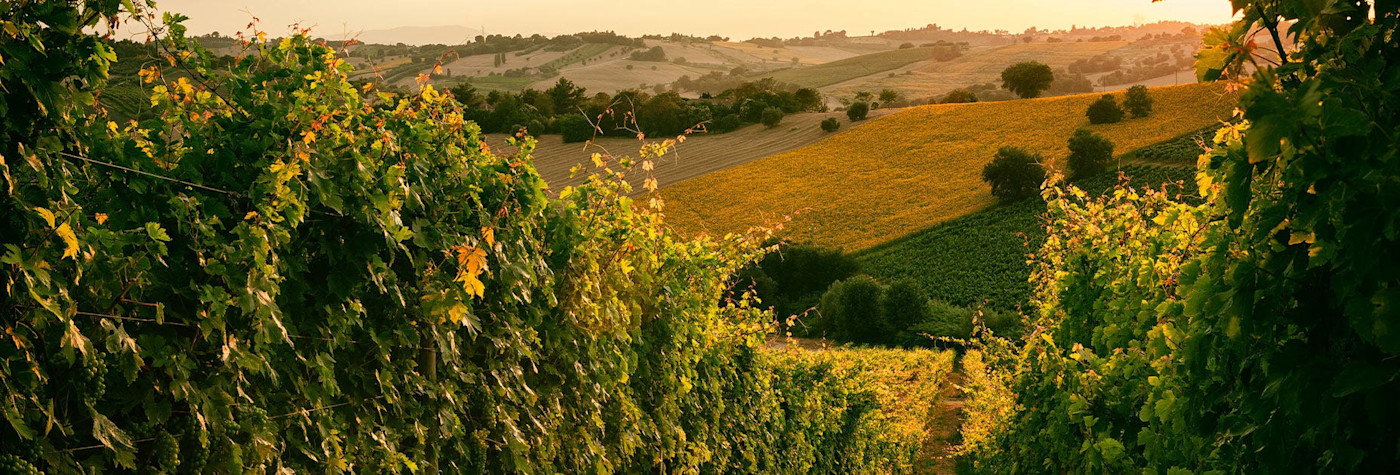
Even though it is located directly on the Adriatic, it is still relatively unknown. Together with Tuscany and Umbria, Marche forms the heart of central Italy, and is just now becoming a tourist destination. The region is a late bloomer when it comes to wine as well. Could this be due to the fact that it is off the main Milan–Rome trade route? Or the fact that there is no city here larger than picturesque little Ancona? Whatever the reason, this area, nestled between the Apennines and the Adriatic – with its forests, fields and vineyards, its churches, abbeys and castles – is definitely worth exploring.
The liberation of Verdicchio
The Marche wine region shares some similarities with neighbouring Tuscany and Umbria, such as calcareous soil and hilly topography. The northern part of the region, around regional capital Ancona, has a continental climate, while the southern part is influenced by the Mediterranean. Vineyards cover a total area of 25,000 hectares.
The most important grape variety is Verdicchio. In the past it often yielded very rustic white wine. Today, however, winemakers are putting their modern knowledge to use to press floral, mineral, full-bodied wines that pair optimally with the fish dishes from the nearby coast. The grape’s most famous place of origin is called Castelli di Jesi. Verdicchio di Matelica is also an inside tip among connoisseurs.
Among red wine, Sangiovese is king here. In Marche its quality varies though. The region’s second major red wine grape is more exciting: Montepulciano. Introduced from Abruzzo, which borders Marche to the south, it has no connection to the village of Montepulciano in Tuscany. This distinctive variety is a joy for wine lovers, yielding robust, full-bodied, mineral reds. The most interesting examples – which are still affordable to boot – are produced in the Cònero area.
Also worth discovering: Rosso Piceno. The southernmost part of Marche produces the best examples of this red wine. It is a blend combining the elegance and complexity of Sangiovese with the fullness and structure of Montepulciano.
Deliciously hearty specialities
There is one thing you absolutely must do in Marche: eat. The region which produced the great opera composer Gioachino Rossini (1792-1868) is heaven for gourmands. To give just one example, Brodetto, which is the traditional fish stew eaten on the coast, contains no fewer than 13 different kinds of fish. But even more popular are the hams and pork sausages from the inland areas. And they don’t skimp either – these foods are not thinly sliced but served in generous portions. Every housewife makes her own tagliatelle at home. More than anything else, though, the Marchigiani love their food gratinée, stuffed and seasoned with sauces. The best example of this is Tournedos Rossini: a fillet of beef cooked to medium then topped with dry-cured ham, placed on toast, covered in béchamel sauce and cheese, then baked. As if that weren’t enough, it is finished off with a generous amount of shaved white truffle. Even the local Tenera ascolana olives are stuffed with a mix of meat and Parmesan.
docg areas in Marche
Cònero, Castelli di Jesi Verdicchio Riserva, Offida, Verdicchio di Matelica Riserva, Vernaccia di Serrapetrona
doc areas in Marche
Bianchello del Metauro, Colli Maceratesi, Colli Pesaresi, Esino, Falerio, I Terreni di Sanseverino, Lacrima di Morro oder Lacrima di Morro d’Alba, Pergola, Rosso Cònero, Rosso Piceno, San Ginesio, Serrapetrona, Terre di Offida, Verdicchio dei Castelli di Jesi, Verdicchio di Matelica
Key Producer
Bisci, Colonnara, Fazi Battaglia, Garofoli, Le Terrazze, Umani Ronchi